
Stocks, Bonds, and Funds: What Each One Actually Does in a Portfolio
Understand what stocks, bonds, and funds each contribute to a retirement portfolio and why owning a mix of all three matters.
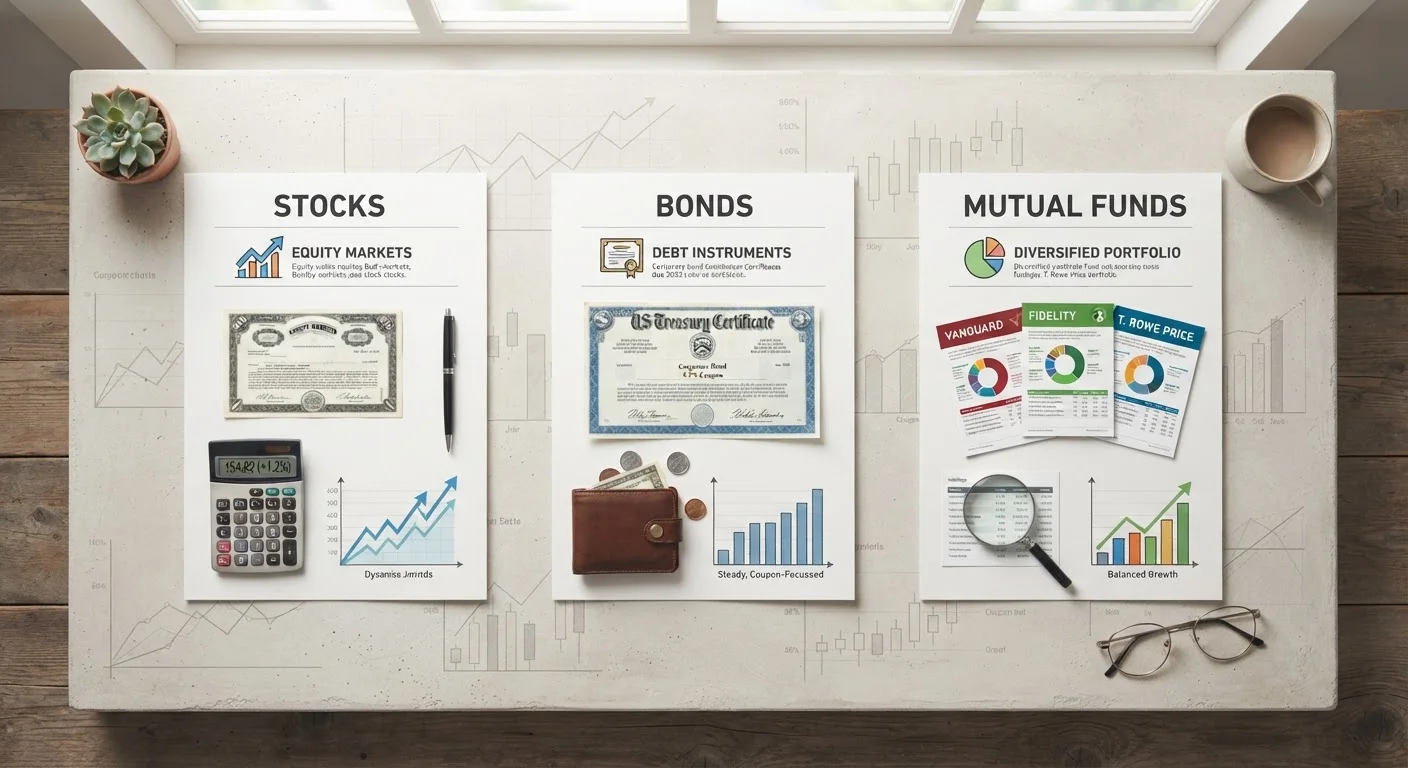
Photo: investorspaces.com editorial
—— In This Article
Key Takeaways
- Stocks provide growth potential but carry higher short-term price risk than bonds.
- Bonds generate income and reduce portfolio volatility, especially near or during retirement.
- Funds, whether mutual funds or ETFs, give investors instant diversification across many securities.
- Asset allocation, the percentage split among stocks, bonds, and funds, shapes how a portfolio behaves over time.
- Combining asset classes lowers the chance that one bad outcome wipes out the whole portfolio.
- A qualified financial adviser can help you choose an allocation suited to your specific timeline and goals.
What stocks actually do in a portfolio
When you buy a share of stock, you become a part-owner of the company that issued it. If the company grows and earns more profit, its share price tends to rise. Many companies also pay dividends, which are periodic cash distributions to shareholders, giving investors a second source of return alongside price appreciation.
For retirement savers, stocks are the primary growth engine. Over long periods, broad equity markets have historically delivered higher returns than bonds or cash, though past performance does not guarantee future results. That growth comes with a trade-off: stock prices can fall sharply in a short period. A portfolio that holds only stocks may grow quickly during bull markets but can lose a large portion of its value in a downturn.
The practical implication is that stocks work best when you have time to ride out volatility. Investors with decades before retirement can generally tolerate a heavier stock allocation. Those within a few years of drawing down savings often reduce stock exposure to protect against a bad year arriving at the worst possible moment. For a fuller picture of how allocation decisions interact with time horizons, see asset allocation fundamentals.
What bonds contribute to a portfolio
A bond is a debt instrument. When you buy one, you are lending money to a government or corporation for a fixed term. In return, the issuer pays you interest, usually at regular intervals, and repays the principal when the bond matures. That predictable cash flow is what makes bonds useful for income-focused investors and retirees.
Bonds also tend to be less volatile than stocks. When equity markets fall, investors often move money into bonds, which can push bond prices up. This inverse tendency is not guaranteed, but it is the reason a blended portfolio often suffers smaller overall losses during a stock market decline than a pure equity portfolio would.
Bond prices and interest rates move inversely
When interest rates rise, the market prices of existing bonds generally fall, because newly issued bonds offer higher yields and existing ones become comparatively less attractive. Duration measures how sensitive a bond's price is to rate changes: longer-duration bonds feel a larger price swing for the same rate move. Yield, duration, and credit risk explained covers these mechanics in detail.
Bond prices and interest rates move in opposite directions. When rates rise, existing bond prices fall. Duration, which measures a bond's sensitivity to rate changes, matters when choosing which bonds to hold. Yield, duration, and credit risk explained covers these mechanics in detail.
What funds add that individual securities cannot
A fund, whether a mutual fund or an ETF, pools money from many investors and uses it to buy a collection of securities. Owning one fund can give you exposure to dozens, hundreds, or even thousands of individual stocks or bonds simultaneously. That instant diversification is difficult to replicate by buying individual securities, especially with a modest starting balance.
Index funds, a subset of mutual funds and ETFs, track a market index such as the S&P 500 rather than relying on a manager to pick securities. Because they follow the index mechanically, they tend to carry lower costs than actively managed funds. Lower costs matter over decades of compounding: fees paid to a fund manager reduce the amount left to grow.
Target-date funds go one step further by automatically adjusting their stock-to-bond ratio as your expected retirement year approaches, shifting toward bonds over time without requiring you to rebalance manually. They are a common choice inside 401(k) plans for investors who prefer a single, self-adjusting holding.
For context on the full range of accounts and income sources that funds fit into, the overview of retirement income streams is a useful companion read.
How the three asset types work together
Owning stocks, bonds, and funds separately is not the goal. The goal is a portfolio where the three interact to balance growth and stability across your investment timeline.
A straightforward way to think about it: stocks provide the return potential that grows wealth over time, bonds provide stability and income, and funds provide the diversification and cost efficiency that make both achievable without managing dozens of individual positions. Combining them means that a steep drop in equity markets does not translate directly into an equal drop in the full portfolio, because bonds and other holdings may hold their value or recover faster.
Asset allocation, the percentage of your portfolio in each category, determines how this balance actually behaves. A portfolio with 80% stocks and 20% bonds will grow faster in a rising market and fall harder in a declining one than a portfolio split 50/50. Neither is universally correct. The right balance depends on your timeline, the income you expect to need from the portfolio, and how much short-term loss you can absorb without changing your plan.
Before settling on an allocation, it is worth reviewing the key investing terms every investor should understand to make sure the vocabulary used by your brokerage, plan provider, or adviser is clear. Speaking with a licensed financial adviser can help translate these general principles into a specific allocation suited to your situation.
This article is for informational purposes only and does not constitute personalized investment, tax, or legal advice. Consult a qualified financial professional before making decisions about your own portfolio.
Frequently Asked Questions

Investing Basics Editorial Team
Investing Basics Editorial Team is the collective byline for our editorial team and contributor network. Articles published under this byline or an editorial pen name are researched, written, and reviewed according to our editorial standards for clarity, consistency, and independence before publication.
View author profile