
Sequence of Returns Risk: The Retirement Threat Most Savers Overlook
Poor market returns in your early retirement years can permanently shrink your nest egg. Understand sequence-of-returns risk and strategies to reduce its impact.
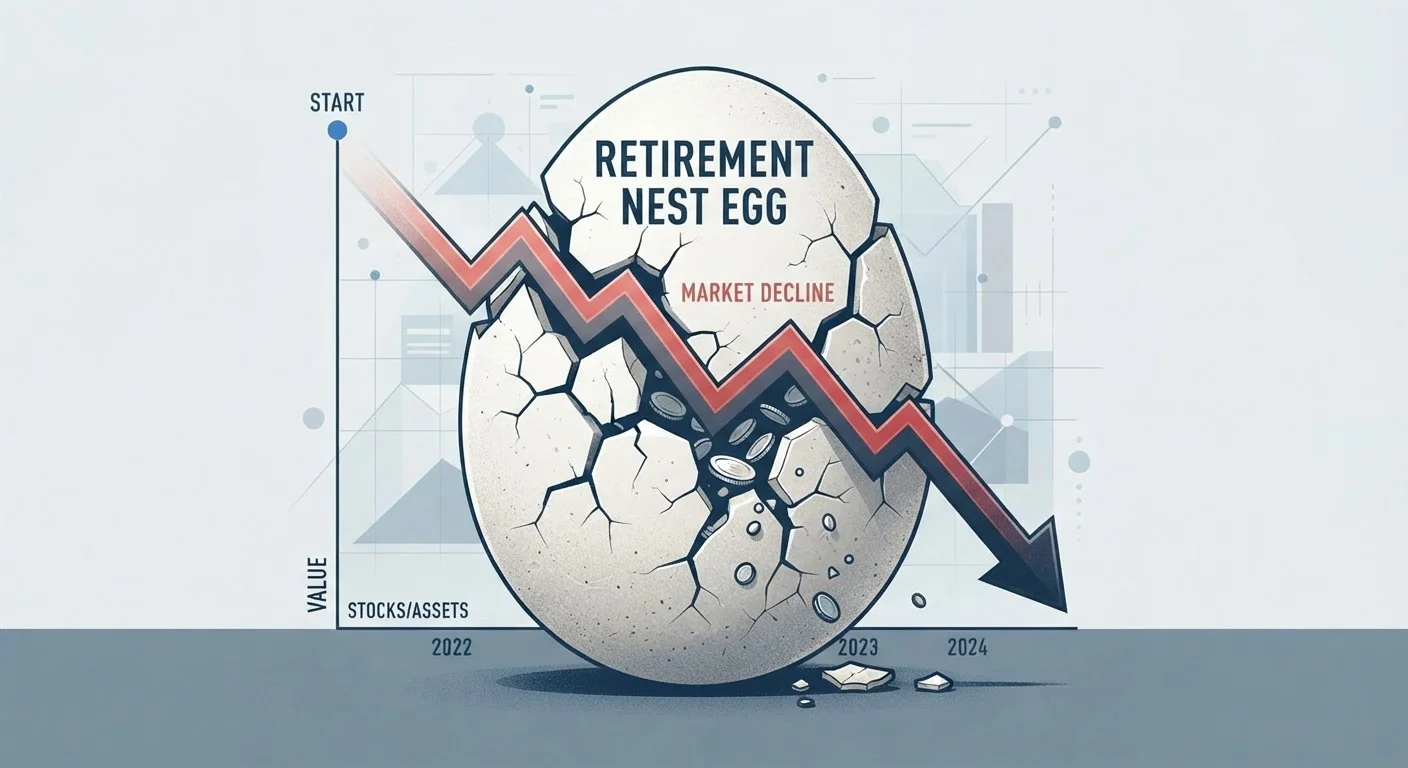
Photo: investorspaces.com editorial
—— In This Article
Key Takeaways
- The order of investment returns matters as much as their average when you are drawing down savings.
- A major market decline in the first five years of retirement can permanently shorten how long your portfolio lasts.
- Delaying large withdrawals, holding a cash or short-term bond buffer, and adjusting spending flexibility each reduce exposure to this risk.
- Sequence of returns risk does not apply during the accumulation phase, only once withdrawals begin.
- Coordinating withdrawal order across account types can limit how much you must sell during a downturn.
Why timing matters more than average returns
Most retirement projections use a single assumed average annual return, say 6% or 7%, applied evenly across 25 or 30 years. That framing obscures a critical reality: the calendar does not distribute returns evenly, and the years around your retirement date carry more weight than any others.
Consider two retirees, each starting with $1 million and withdrawing $50,000 per year. Both experience an average annual return of 5% over 25 years. The difference is that one retiree experiences the worst returns in years one through five, while the other experiences them in years 20 through 25. Research using historical data consistently shows the first retiree runs out of money far sooner, sometimes by a decade or more. The math is straightforward: when you withdraw funds from a declining portfolio, each dollar taken out removes shares that can no longer participate in the eventual recovery.
This is why common investing assumptions about average returns can mislead retirement savers. An average return is not a reliable predictor of portfolio longevity once withdrawals begin.
The mechanics behind the damage
During a market downturn, your portfolio loses value. If you must withdraw $4,000 that month to cover expenses and your fund's share price has dropped 30%, you sell more shares than you would have at the prior price. Those shares are gone permanently. When markets recover, the gains accrue on a smaller base.
This dynamic compounds over time. A portfolio that falls 25% in year one of retirement and then grows at a steady 7% annually will underperform a portfolio that starts flat and then falls 25% in year 20, even though both portfolios contain the identical sequence of annual returns in reverse order. The withdrawal engine turns what would be a temporary loss into a structural deficit.
The retirement red zone: when risk peaks
Sequence of returns risk is most acute in what researchers often call the retirement red zone, roughly the five years before and five years after the retirement date. Poor returns in this window have the longest time to compound negatively against a shrinking portfolio. This is also the period when a worker has the least time to recover through additional contributions.
Sequence of returns risk is most acute in what researchers often call the "retirement red zone," roughly the five years before and five years after the retirement date. Poor returns in this window have the longest time to compound negatively against a shrinking portfolio. This is also the period when a worker has the least time to recover through additional contributions.
Strategies that reduce exposure
No strategy eliminates sequence of returns risk entirely, but several approaches lower the probability that an early downturn derails your plan.
Build a withdrawal buffer. Holding one to three years of anticipated living expenses in cash, money market funds, or short-term bonds lets you avoid selling equities during a downturn. You draw from the buffer while waiting for markets to stabilize, then replenish the buffer when equity values recover. The cost is the opportunity cost of holding lower-returning assets, which is a real tradeoff worth modeling.
Use flexible withdrawal rules. Rather than taking a fixed dollar amount each year, a spending plan that reduces withdrawals by 10% to 15% during down markets can meaningfully extend portfolio life. Vanguard and other large custodians have published research showing that even modest spending flexibility substantially improves the probability of a portfolio lasting 30 years.
Delay Social Security if possible. Every year you delay claiming Social Security past your full retirement age, up to age 70, increases your guaranteed benefit by approximately 8%. A higher guaranteed income floor reduces the portfolio withdrawals you need each month, lowering your exposure during a bear market. You can read more about timing decisions at Social Security claiming strategies.
Sequence your account withdrawals thoughtfully. Drawing first from taxable accounts, then tax-deferred accounts like traditional IRAs, then tax-free accounts like Roth IRAs is one common framework. This preserves tax-advantaged growth where it matters most. Tax-efficient withdrawal sequencing can also reduce the tax drag on your portfolio in years when you must sell assets.
How this interacts with the rest of your plan
Sequence of returns risk does not exist in isolation. A retiree with a higher savings rate going into retirement has a larger buffer against early losses, which is one reason your savings rate matters beyond its direct contribution to account balances. A retiree whose spending has crept upward over the working years, requiring larger monthly withdrawals, faces compounded exposure. Lifestyle creep and sequence risk reinforce each other: higher spending means more shares sold during downturns.
Wealth preservation in retirement, covered more fully in our article on what wealth preservation means in retirement, directly addresses sequence risk alongside inflation risk. Both forces work against a fixed-balance portfolio, and both require proactive structural responses rather than passive reliance on average returns.
Anyone constructing a retirement income plan should model multiple return sequences, not just average projections, before deciding on a withdrawal rate or asset allocation. A qualified, fiduciary financial planner can run those scenarios against your specific timeline and income needs. This article is general educational information and is not a substitute for personalized financial advice.
This article is for informational purposes only and does not constitute personalized financial, investment, tax, or legal advice. Consult a qualified financial professional before making decisions based on your individual circumstances.
Frequently Asked Questions

Retirement Planning Editorial Team
Retirement Planning Editorial Team is the collective byline for our editorial team and contributor network. Articles published under this byline or an editorial pen name are researched, written, and reviewed according to our editorial standards for clarity, consistency, and independence before publication.
View author profile